Bioactive Compounds from Mangosteen Fruit Peels (Garcinia mangostana L.) and Assessment of their Antioxidant Potential
Yves Didier Mboma Nseme
Institute of Agricultural Research for Development (IRAD), P.O. Box. 13 Njombe, Cameroon.
Kevin Fabrice Paul Mandeng
Centre for Food, Food Security and Nutrition Research, Institute of Medical Research and Medicinal Plants Studies, P.O. Box. 13033, Yaoundé, Cameroon.
Jafarou Mounpou
Centre for Food, Food Security and Nutrition Research, Institute of Medical Research and Medicinal Plants Studies, P.O. Box. 13033, Yaoundé, Cameroon.
Imelda Lucresse Nouteza Djuikoo
Centre for Food, Food Security and Nutrition Research, Institute of Medical Research and Medicinal Plants Studies, P.O. Box. 13033, Yaoundé, Cameroon.
Maxwell Wandji Nguedjo
Centre for Food, Food Security and Nutrition Research, Institute of Medical Research and Medicinal Plants Studies, P.O. Box. 13033, Yaoundé, Cameroon.
Roger Moïse Mbanga Baleba
Centre for Food, Food Security and Nutrition Research, Institute of Medical Research and Medicinal Plants Studies, P.O. Box. 13033, Yaoundé, Cameroon.
Hippolyte Tene Mouafo *
Centre for Food, Food Security and Nutrition Research, Institute of Medical Research and Medicinal Plants Studies, P.O. Box. 13033, Yaoundé, Cameroon.
Gabriel Nama Medoua
Centre for Food, Food Security and Nutrition Research, Institute of Medical Research and Medicinal Plants Studies, P.O. Box. 13033, Yaoundé, Cameroon.
*Author to whom correspondence should be addressed.
Abstract
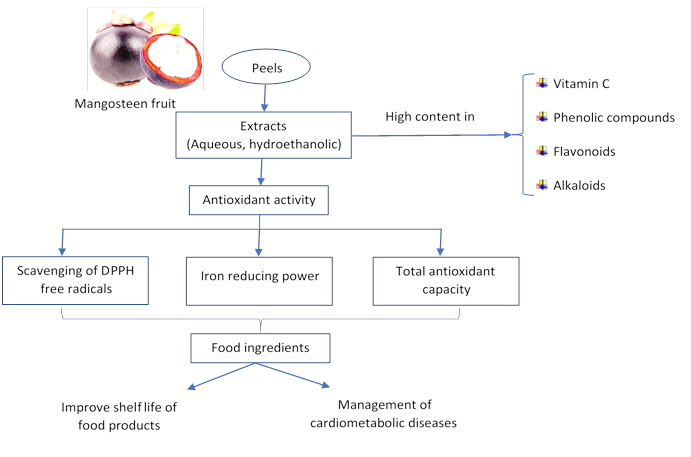
The aim of this study was to quantify the bioactive compounds in mangosteen fruit peels and assess their antioxidant activity. Peels from washed mature fruits of Garcinia mangostana (L.) were dried, crushed, and sieved, and the bioactive compounds were extracted using distilled water and ethanol 70%, and quantified. The antioxidant potential of the different extracts was assessed through their DPPH scavenging activity, iron reducing power, and total antioxidant capacity. Results showed that ethanol at 70% extracted more bioactive compounds compared to water. Total polyphenols content of 57.19 mg GAE/g DM, flavonoids of 35.06 mg QE/g DM, alkaloids of 4.49 mg QuiE/g DM, and vitamin C of 1.42 mg/100g DM were obtained from hydroethanolic (ethanol 70%) extract. As expected, the highest percentage of scavenging DPPH radical (85.98%) was recorded with hydroethanolic extract compared to the aqueous one (44.66%). Similar behaviors were noticed with the hydroethanolic extract regarding the iron-reducing capacity and the total antioxidant capacity. Thus, justifying the positive correlations obtained between bioactive compounds and antioxidant activities although significant (p<0.05) between alkaloids and DPPH scavenging activity. Mangosteen peels is a good source of bioactive compounds that might be potentially used for food preservation and the management/prevention of cardio-metabolic diseases.
Keywords: Mangosteen, fruit, peels, valorization, bioactive compounds, antioxidant activity